





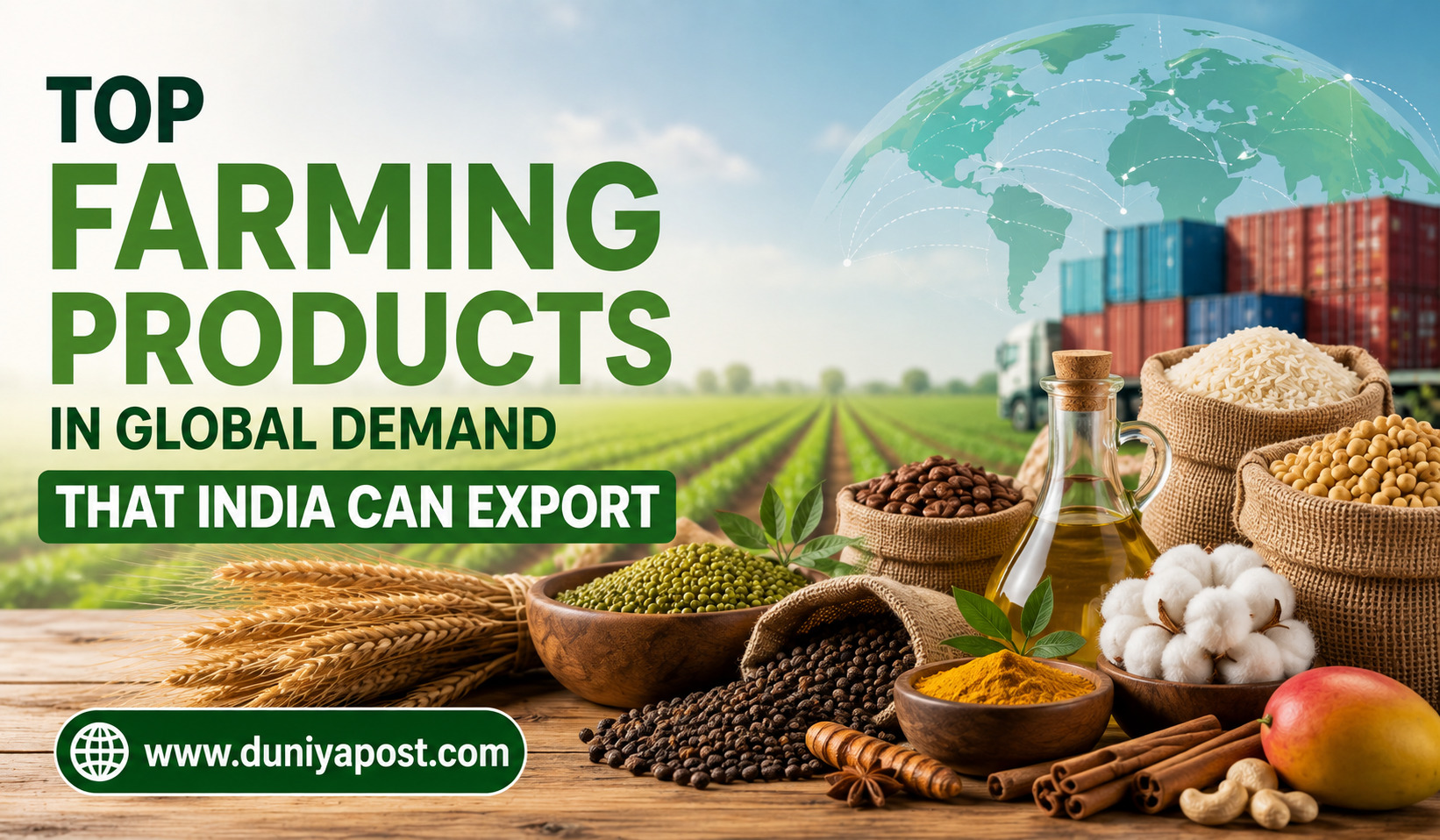
India has quietly become one of the most important names in global agriculture. It’s not just about producing enough to feed 1.4 billion people at home anymore Indian farms are now feeding kitchens in the Middle East, Europe, Africa, and beyond. In FY25, India’s total agricultural exports touched roughly $52 billion, growing faster than the country’s overall merchandise exports during the same period. That’s not a small side business. It’s one of the fastest-growing pieces of India’s trade story.
If you’re a farmer, an exporter, or simply someone curious about which Indian agricultural products are in demand worldwide, here’s a look at the farm products the world can’t seem to get enough of, and why they’re in such high demand.
A few markets keep showing up as the biggest buyers across almost every category:
- United States
- China
- Saudi Arabia and the UAE
- Southeast Asian nations like Indonesia and the Philippines
1.Rice: India’s Biggest Agricultural Export Story
Rice is where India truly dominates global agricultural trade. The country has overtaken China to become the world’s largest rice producer, and its export numbers back that up in a big way India ships out more rice than Thailand and Vietnam combined. Basmati rice remains the crown jewel here, prized across the Middle East for its aroma and long grain, while non-basmati rice moves in bulk to countries like Indonesia, the Philippines, and several African nations dealing with their own supply gaps.
What makes rice such a strong export bet right now is how central India has become to global price stability. When India tightened its rice export policy a couple of years ago, global prices jumped noticeably, which says a lot about how much the rest of the world depends on Indian supply. For exporters, that’s both an opportunity and a responsibility buyers want consistency as much as they want volume.
2.Spices: Small Volume, Big Value
Spices might not carry the same tonnage as rice, but they punch well above their weight in value. India’s spice exports crossed $4.5 billion recently, driven by staples like turmeric, cumin, chili, and cardamom. Global food trends are actually helping this category grow as more consumers abroad look for natural flavoring and functional ingredients like turmeric for its perceived health benefits, Indian spice exporters are finding new buyers well outside the traditional South Asian diaspora market.
The opportunity here isn’t just raw spice powder either. Buyers increasingly want traceable, lab-tested, contamination-free products, and exporters who can prove quality consistency are winning contracts even when their pricing isn’t the cheapest on the table.
3.Marine Products: A Quiet Giant
Marine exports don’t always get the spotlight, but they’re one of India’s largest agri-export categories by dollar value, bringing in well over $7 billion a year. Shrimp leads the pack, with the US, China, and several European markets buying heavily. Coastal states like Andhra Pradesh and Gujarat have built strong aquaculture ecosystems specifically geared toward export-grade shrimp and fish, and that infrastructure keeps attracting more international buyers looking for reliable, large-scale suppliers.
4.Coffee: A Record-Breaking Category
Indian coffee had a standout year, with exports hitting an all-time high and jumping around 40% in value in a single year. Much of this comes from Karnataka’s coffee belt, where Arabica and Robusta beans are grown under shade, giving Indian coffee a distinct flavor profile that’s found a growing audience in Europe and the Middle East. As global coffee prices have climbed due to supply issues in traditional coffee-producing countries, Indian coffee has stepped in as a reliable, quality alternative.
5.Pulses: Feeding the World’s Protein Demand
As more people worldwide shift toward plant-based protein, pulses have become one of India’s most consistently profitable export categories. India isn’t just the world’s largest pulse producer it also exports significant volumes to Canada, the US, and the UAE. Lentils, chickpeas, and pigeon peas are the biggest movers, and demand keeps rising as international buyers look for affordable, high-protein staples that fit into both traditional diets and the growing plant-based food movement.
6.Fresh Fruits and Vegetables: Riding the Premium Wave
Alphonso mangoes, pomegranates, grapes, and bananas have turned Indian fresh produce into something of a premium category abroad, especially in the UAE and UK during peak season. What’s changed in recent years is logistics better cold-chain infrastructure and faster transit times mean Indian fruit can now reach European and Middle Eastern shelves while still fresh, something that simply wasn’t reliable a decade ago. Onions and other vegetables also move in large volumes to Gulf and Southeast Asian markets, particularly when supply from other exporting countries tightens.
7.Cotton and Oilseeds: The Industrial Side of Agriculture
Not every export is something you’d find on a dinner plate. Raw cotton remains a major earner, feeding textile industries across Asia, while castor oil, largely grown in Gujarat, has carved out a near-monopoly position globally thanks to its use in everything from pharmaceuticals to industrial lubricants. These categories don’t always get discussed alongside food exports, but they’re a meaningful part of India’s agricultural trade engine.
Why this growth is happening now?
A few things are converging to push Indian agri-exports higher. Global buyers are increasingly prioritizing reliability and quality consistency over rock-bottom pricing, which favors exporters who invest in proper certification and lab testing. India’s processed food exports have also grown significantly as a share of the total basket, meaning the country is shifting from just shipping raw commodities to exporting higher-margin, value-added products. On top of that, climate and supply disruptions in competing exporting nations have repeatedly pushed international buyers toward India as a steadier alternative.
What this means if you’re exporting?
If you’re a farmer or trader thinking about entering the export market, the products above are a good starting map, but the real differentiator today isn’t which crop you grow it’s how well you can prove its quality. Before you can ship anything abroad, there are a few basics to sort out:
- An Import Export Code (IEC) from the DGFT
- Registration with the relevant Export Promotion Council for your product, such as APEDA for fruits and vegetables or the Spices Board for spices
- Lab testing and quality certification suited to your target market
- Reliable cold-chain or packaging arrangements, depending on the product
Beyond the paperwork, buyers are paying close attention to lab testing, packaging standards, and supply consistency, since a single failed quality check can cost a long-term contract.
India’s agricultural export story isn’t slowing down anytime soon. With rising global demand for reliable, high-quality food supply, and India’s own infrastructure and processing capabilities improving year over year, farmers and exporters who focus on quality and consistency are the ones best positioned to grow with it.